I ended the last post on a question: what’s on your list right now that you can’t defend out loud? If you actually sat with that for more than ten seconds, you probably end up understanding the real problem: you don’t have a plan.
“Track it or it didn’t happen” only works when what you’re tracking is observed from altitude … when it can tell you not just what’s coming, but when, why it matters, and what it costs you to say yes to that thing that just landed in your inbox.
A list tells you what’s outstanding. A plan tells you where you are in the year and what you’re allowed to say no to.
Those are not, and cannot be the same document. Treating them as the same document is how a genuinely well-intentioned PMM ends up with forty open items and zero sense of whether this is a good week or a bad one.
So this is the “how.” Not another hand wave to “prioritize better”, you’ve heard that one. This is an actual structure you could use, along with a fillable template you can edit in the browser and export as an image, a Markdown file, or a PDF.
You Have Too Many Calendars
Here’s why this problem lands harder on PMM than most functions.
- Product runs on a (hopefully) durable strategy but an execution roadmap that shifts every sprint.
- Sales runs on an annualized but tracked quarterly quota calendar, along with whatever deal is closing on Thursday.
- Marketing runs on a campaign calendar built weeks and months in advance.
- Events run on a calendar set by a conference organizer and driven in a T-minus workback with 17 swimlanes of which 8 are PMM.
Every one of those calendars is a legitimate business process, every one of those owners is doing their job correctly, and none of them is responsible for reconciling their calendar with anyone else’s.
Guess who’s sitting in the middle of that Venn diagram, again.
This is the same structural position I wrote about in the random acts piece, the one that makes PMM a magnet for unplanned inbound. It’s also exactly why a plan that only covers “my department’s stuff” doesn’t survive first contact with reality. Your plan has to absorb inputs from calendars you don’t own and don’t control the timing of, which means it needs to work at more than one zoom level at once. That’s the whole reason a single flat list falls apart the moment it gets past about fifteen items: it has no altitude, so everything on it looks equally urgent, and nothing on it tells you how the quarter is going.
That’s not a plan. That’s noise with deadlines.
Side note: If you’re a founder and nobody at your company owns that intersection today, that’s not a scrappiness win. It’s usually the first real sign that your next marketing hire needs to be a PMM.
Altitude One: The Annual View
This is the map, not the itinerary. The annual view exists to answer one question: what’s already fixed on the calendar this year. Major product launches, your company’s seasonal windows (renewal season, a big industry event, the enterprise sales cycle wrapping in Q4), roadmap milestones that are firm enough to plan around even if the exact date moves a little.
Note: “firm enough to plan around” is doing some real work in that sentence. The annual view is not a promise that these dates won’t move, it’s an acknowledgment that you already know the shape of the year even before every detail is locked. If you wait for total certainty before you write anything down, you’ll never start planning.
The annual view should be short. If it has more than eight or ten entries, it’s stopped being a map and started being a list wearing a map’s clothing. Its job is to give you and your leadership team reviewing it a shared sense of the year’s shape, not to capture everything you might do.
Altitude Two: The Quarterly Forecast
This is where the annual view gets honest. A roadmap a year out is a hypothesis. A roadmap this quarter is closer to a commitment. The quarterly forecast is the rolling translation layer: it takes whatever’s firmed up since you last looked and turns it into an actual 90-day plan, with the specific launches, campaigns, and enablement work that need to happen to hit the annual milestones sitting in that window.
This is also the altitude where trade-offs get named out loud, not absorbed quietly. If a launch slips from Q2 into Q3, that’s not just a scheduling update, it’s a conversation about what else in Q3 now has to move to make room. The quarterly forecast is what makes “yes, but” possible as a sentence you can say, because you have a visible, current answer to “what would this bump.”
This is a rhythm. You should have next quarter looking fairly solid half way through the current one, and a heavy wet pencil layout of the one after. Reforecast every quarter, on purpose, not just when something breaks. A forecast that only gets touched in a crisis isn’t dynamic, it’s just a static asset with manual update steps.
Altitude Three: The Weekly List
This is the ground floor, the actual to-dos, and it’s the only altitude most PMMs have ever built explicitly. It’s necessary, but it is nowhere near sufficient. The test for anything that lands here is simple: it needs to trace back up to something in the quarterly forecast. If it doesn’t, it’s either a genuine opportunistic item (more on that in a second) or it’s a random act of marketing that snuck in wearing a task’s mask.
The weekly list is also your early warning system. When you notice the same kind of task showing up week after week and it’s never on the quarterly forecast, that’s not a personal productivity problem, that’s a gap in your plan that a real ask keeps finding.
The 80% Rule
The suggestion I offer as advice: plan to no more than 80% of your capacity.
I don’t mean this as a wellness platitude. I mean it structurally. You already know, with near complete certainty, that opportunistic work is going to land on you. Not which piece, not exactly when, but that something will land that isn’t on the forecast today and will need real time regardless. A plan built at 100% capacity isn’t ambitious or smartly using capacity. It’s wrong on the day you finish writing it, because it has nowhere to put the thing you knew was coming and just couldn’t name yet.
Twenty percent headroom is not slack you failed to fill. It’s the one honest way to plan around a category of work you can’t predict the specifics of but can predict the volume of. Leaders who see a plan running at 80% shouldn’t read that as under-planning, and if yours does, that’s worth a direct conversation about realities and perhaps your chance to transparently float up what happens on the daily.
AI Helps Differently Here
I’ve written before about AI absorbing execution tax, drafting faster, clearing the blank page. That’s real, but it’s not the interesting part of this particular problem. The interesting part is reconciliation.
The three altitudes only work if they stay in sync with each other, and keeping three moving assets in sync by hand is exactly the kind of unglamorous bookkeeping that quietly stops happening around three weeks after the last scrub. This is where AI is a genuine force multiplier rather than a content-drafting tool: feed it your weekly list and your quarterly forecast, and have it flag the moment a slipped weekly task means the quarter needs updating, or the moment a quarter is quietly drifting from the annual view before you find out about it secondhand in a leadership meeting. It can’t decide what the plan should say. It can absolutely make sure the plan still tells the truth about itself, at every altitude, every week, without you personally holding all three documents in your head at once.
I’ll also flag that I am deliberately skipping getting into complex tools like Asana, Jira, monday.com and the like … they’re awesome tools, and if you have access to them and business workflow to use them, awesome. My observation is that these tools are often not used or just not well managed, so taking the lowest aspect of documents here :)
Plan on a Page
All of this collapses into something you can put in front of a VP, and it’s worth building deliberately, rather than reconstructing from memory every time someone asks “so what are you working on.” Here’s a super simple example:
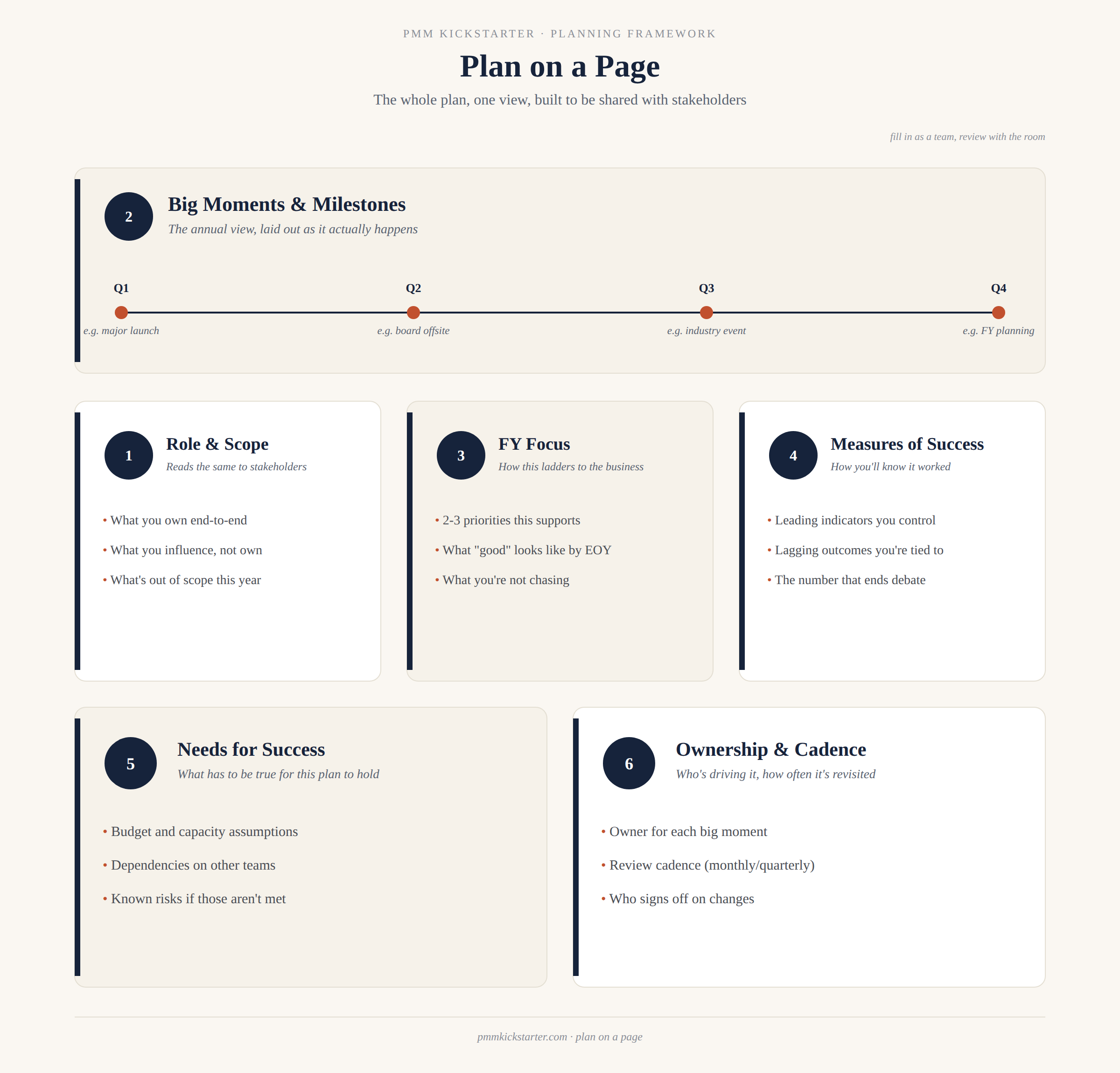
Six key aspects on a slide (or page).
- Your role and scope, so it reads the same to you and to the person reviewing it.
- Big moments and milestones, laid out as an actual timeline instead of a list, because a plan you can see happening across the year hits differently than a plan you have to imagine happening.
- FY focus, so anyone looking at this can see how it ladders to what the business actually cares about.
- Measures of success, because “how will we know this worked” is usually the first question a leader asks and the one most plans answer last, if at all.
- Needs for success, the budget, capacity, and dependencies that have to hold for any of this to be real.
- And ownership and cadence, because a plan nobody’s named as responsible for, and nobody’s committed to revisiting, is a slide, not a plan.
Fill it in as a team if you can, and review it as a group. Feed it to the robots to assimilate the info, spot overlaps and gaps, dependencies and joint expectations. It’s meant to be argued with before it’s meant to be admired.
Grab the fillable version if you want to skip building this from scratch: fill it in right in the browser, then export it as an image to share, a Markdown file to hand to your AI tool of choice, or a PDF to print.
A Planful Conclusion
A list will always feel more honest than a plan, because a list is just what’s true right now. A plan requires you to make a claim about the future and defend it, which is scarier and also the entire job. The PMMs I’ve seen build real influence aren’t the ones with the longest backlog, they’re the ones who can put a single page in front of a VP and answer every question it raises without having to go check something first.
You already have the list. What altitude is it missing?
Adam