I remember exactly what manual PMM workflows feel like because I lived in them for years. Every asset built from scratch. The blank page problem was so real, glaring white just burning into your eyeballs as you sighed into your coffee and began the arduous task of drafting. No shortcuts, quick 5 iterations to get you to the fun place of humanizing, just you and the blank canvas. Every PMM who has worked this job pre-AI have their own version of this memory. If you are just starting out, trust me you got lucky with your timing.
There are a few PMM frameworks out there, they’re all valuable in different ways, and of course I’ve been pondering what my own framing would be. I ended up with more of a maturity journey than a framework, because in my opinion, the exact destination for this journey is not defined yet, nor is it singular in nature. Each of us will live somewhere on the curve, and exactly where will depend on our specific role, the company, the industry, the team, the product. Just like many things in product marketing, the answer is “it depends”. Because of course it does.
The Curve
Here’s the shape of it: 5 stages with different operating models.
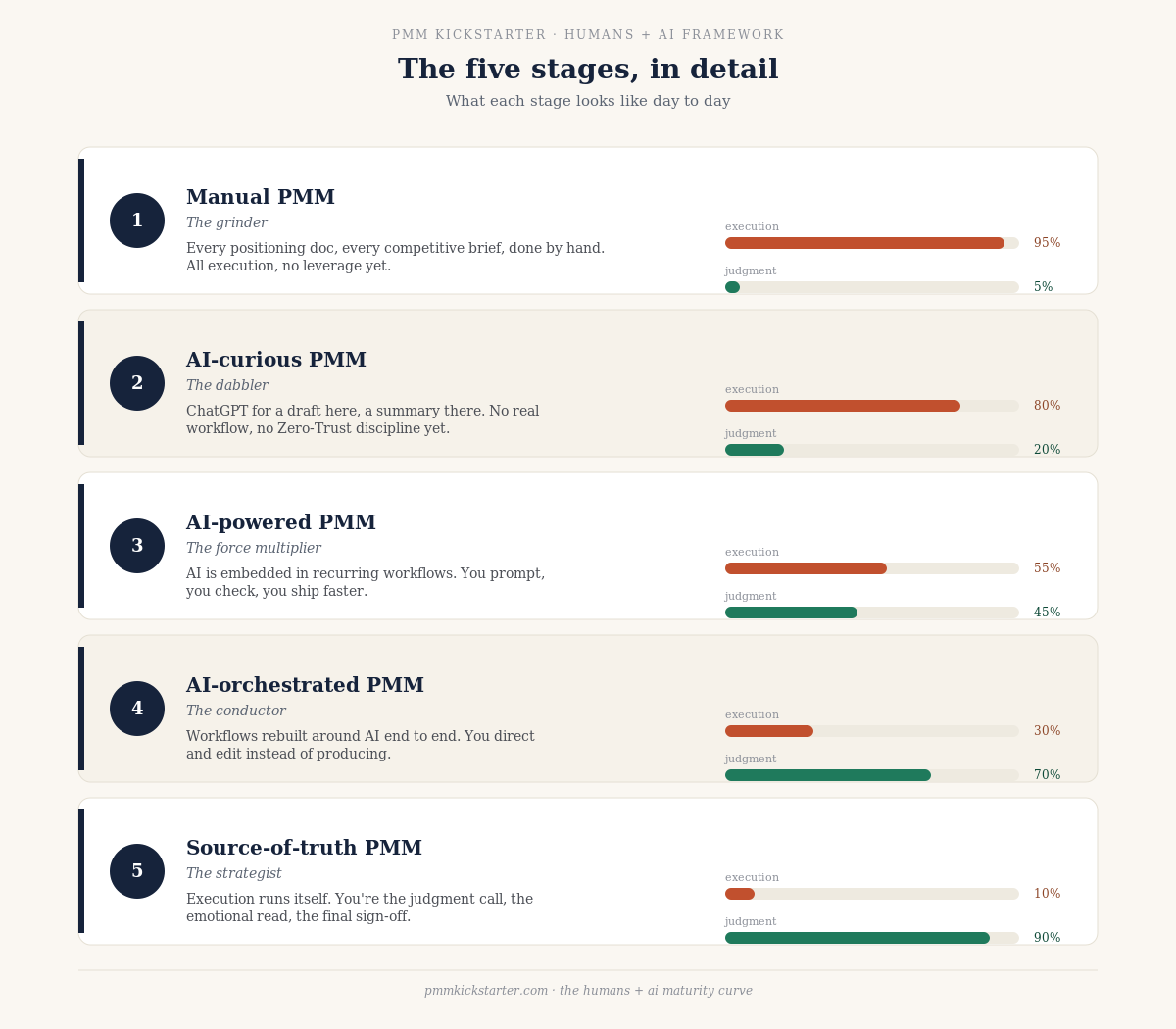
- Manual PMM: The Grinder. All execution, no leverage yet.
- AI-curious PMM: The Dabbler. ChatGPT for a draft here, a summary there. No real workflow, no Zero-Trust discipline yet.
- AI-powered PMM: The Force Multiplier. AI is embedded in recurring workflows. You prompt, you check, you ship faster.
- AI-orchestrated PMM: The Conductor. Workflows rebuilt around AI end to end. You direct and edit instead of producing.
- Source-of-truth PMM: The Strategist. Execution runs itself. You’re the judgment call, the emotional read, the final sign-off.
Stage one is where I started my career, and where a lot of people still are today, whether by choice or because nobody’s handed you an AI budget yet. All execution, no force multiplier yet. I find myself today in a mix of Stage 2 and Stage 3 with the odd touch of Stage 4. Stage five is where I think this discipline lands in three to five years, and I’d be surprised if it takes longer. The technology alone doesn’t get us there. The PMMs who move fastest through this curve become impossible to compete with, and that pressure will drive the rest of the field forward.
Important Side Note: I’m not saying every PMM ends up at stage five by some fixed date. I’m saying the curve itself is the destination for the discipline. Some of you will camp out at stage three for a good long while, and that’s quite fine, and in some cases, a good outcome. “It depends” on your company, your tools, your own appetite for rebuilding how you work. But the direction of travel is not really up for debate.
What moves you along the curve is rebuilding your actual workflow around the tools, not just adopting more of them. The difference between stage two, AI-curious, dabbling with a chatbot for a draft here and there, and stage three, AI-powered, where AI is embedded in your recurring work, is entirely about discipline, not access. Anyone can open a chat window, not everyone can dig into the feature set and build a new system.
The Important Part
I’d be disappointed if you just nodded along with this and accepted that the robots are taking over. I don’t think they are or will. It’s not just AI, it’s us humans too.
Look at the model again. At stage one, you’re spending nearly all your time on execution: drafting, formatting, chasing down information, building the eleventh version of a one-pager. At stage five, that flips almost entirely. Execution is something that happens, largely on its own, supervised. Your time goes to judgment, collaboration, and assessing the emotional messaging angle that’s technically accurate and will land with your specific buyer and problem space, and making the call on what actually gets communicated.
That’s the journey we are on. AI solves the blank page problem, absorbs the heavy execution tax, and allows us humans to get time back. And what we do with that time is where this either becomes a real edge or a wasted opportunity, because freed-up time doesn’t automatically mean better outcomes. We get the better outcomes if we spend it on the 20% that was always the hard part: intuition, empathy, and emotional resonance, the stuff a vibe engine can simulate but never actually feel.
I’ll go one step further, and say I believe the volume of work we get done goes up too, in addition to the shift in ratio.
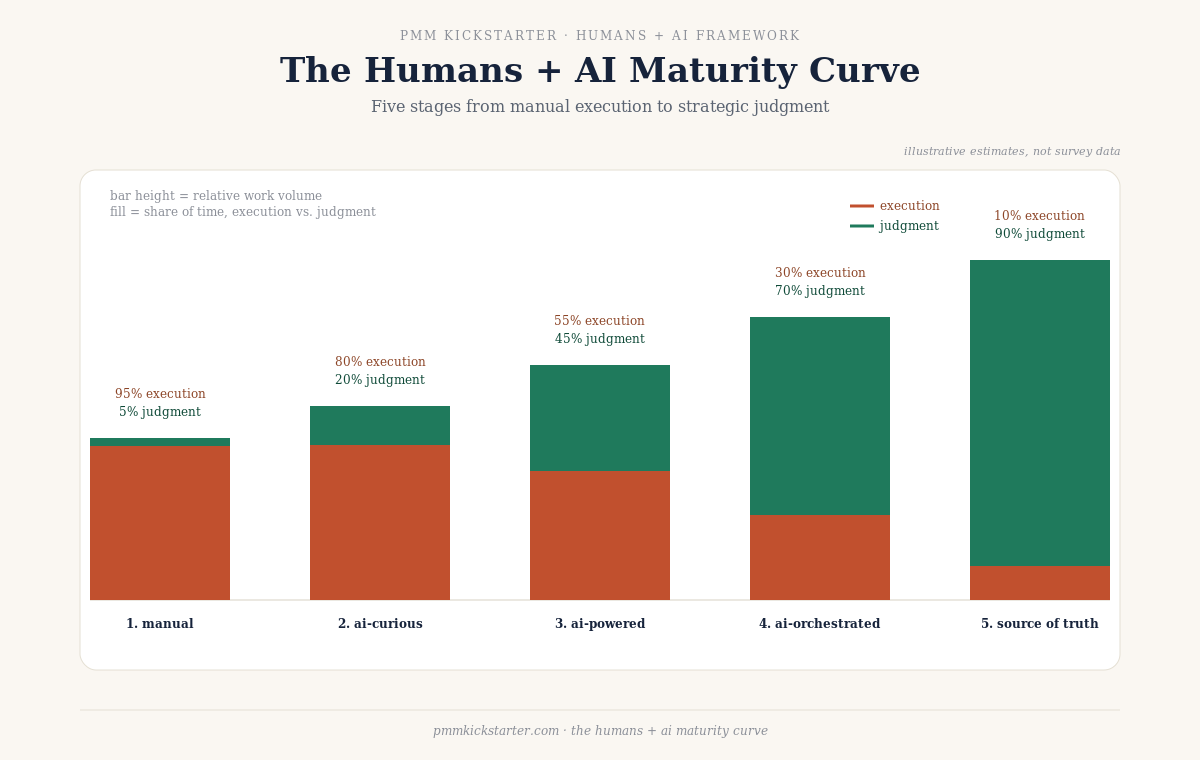
The volume of work at each stage goes up because AI clears the execution backlog fast enough that scope expands to fill the space. More positioning tested. More segments covered. More launches run properly instead of the two that get the “real” treatment while the rest limp out the door. The judgment work doesn’t just take a bigger slice of the same pie. The pie gets bigger, and judgment ends up carrying most of the extra weight.
This is why “AI will replace PMMs” is not a fear I have, and also why “I don’t need to change anything” is also the wrong stance. Neither one survives contact with the journey. The PMMs who move along it become the connective tissue between Product, Sales, and Marketing at a scale one person couldn’t touch five years ago. The ones who don’t move are still doing stage-one work while the market quietly reprices what a PMM is supposed to deliver.
Go build your own version
Pick up this thinking, use what works for you, ignore the rest. Go read a few others work on this topic. Every stage on this curve still needs Zero-Trust fact-checking. That doesn’t fade as you move up … if anything it gets more important, because a stage-five PMM is signing off on more output touching more of the business, faster, with less of it personally drafted by hand. The PMM stays the Source of Truth at every stage, and that’s not a nostalgic holdover from the manual era. It’s the actual job, at every point on the journey.
Where do you think your destination on this journey is? Don’t say 5. Not just yet anyway.
Adam